

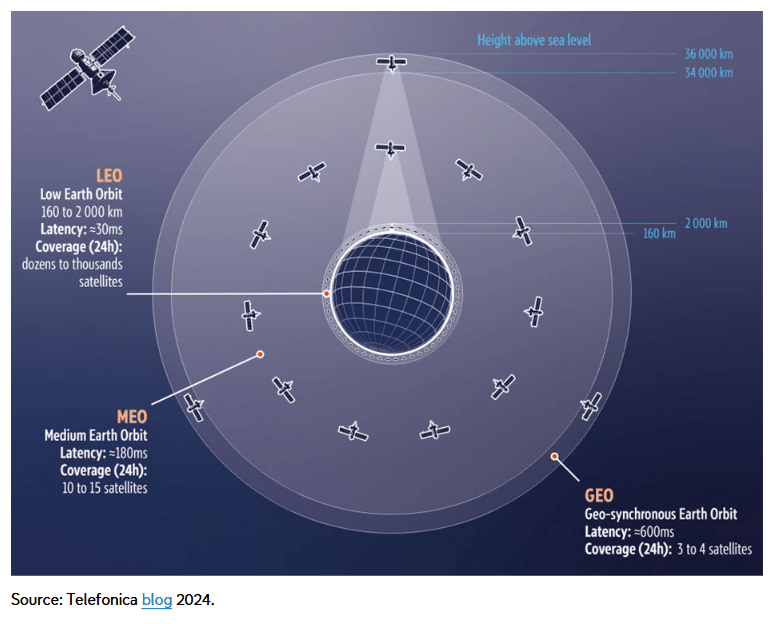
Although the space beyond Earth’s atmosphere is vast, satellite space services use three main orbits:
• Geostationary Earth orbit (GEO) – These satellites travel at an altitude of around 36 000 km from the Earth’s surface. By having an identical orbit rotational speed to Earth’s rotation, they appear stationary relative to a point on the ground. This ‘stationary’ position allows GEO satellites to provide continuous coverage over a wide area, making them ideal for applications such as weather forecasting, television, and low-speed internet services, where latency is a lesser concern.
• Low Earth orbit (LEO) – These satellites are much smaller and orbit relatively close to the Earth’s surface, generally at an altitude of less than 2 000 km. LEO systems have a smaller coverage area per satellite, requiring a constellation of satellites to achieve continuous service. However, due to their proximity to Earth, LEO satellites benefit from low latency. This makes them ideal for high-speed internet services and latency-sensitive applications such as video conferencing.
• Medium Earth orbit (MEO) – These satellites operate at a wide range of altitudes between LEO and GEO orbits. MEO satellites are commonly used for global positioning systems (GPS) and other navigation applications, such as the European Galileo system (e.g. flight tracking). By offering global coverage with fewer satellites than LEO constellations as well as lower latency than GEO systems, they provide a good balance for services requiring both extensive coverage and a short response time, such as internet services and precision agriculture.


Comments are closed for this post.